
How to Make a Budget
Learn how to make a personal or household budget with income, expenses, the 50/30/20 rule, zero-based budgeting, a monthly example, mistakes, troubleshooting, and FAQs.
Quick Answer
To make a budget, write down your monthly take-home income, list fixed expenses, estimate variable expenses, choose a method such as 50/30/20 or zero-based budgeting, set spending limits for each category, include savings and debt payments, track actual spending, and adjust the plan every month. This guide is educational, not personalized financial advice.
What You Need Before Making a Budget
- Your monthly take-home income after taxes and deductions
- Recent bank, card, wallet, or cash spending records
- Recurring bills such as rent, utilities, insurance, subscriptions, and loan payments
- Savings goals, debt-payment goals, and upcoming irregular expenses
- A simple notebook, spreadsheet, budgeting app, or printable budget template
- A realistic view of your own financial situation before making decisions
Step-by-Step Instructions
- Step 1
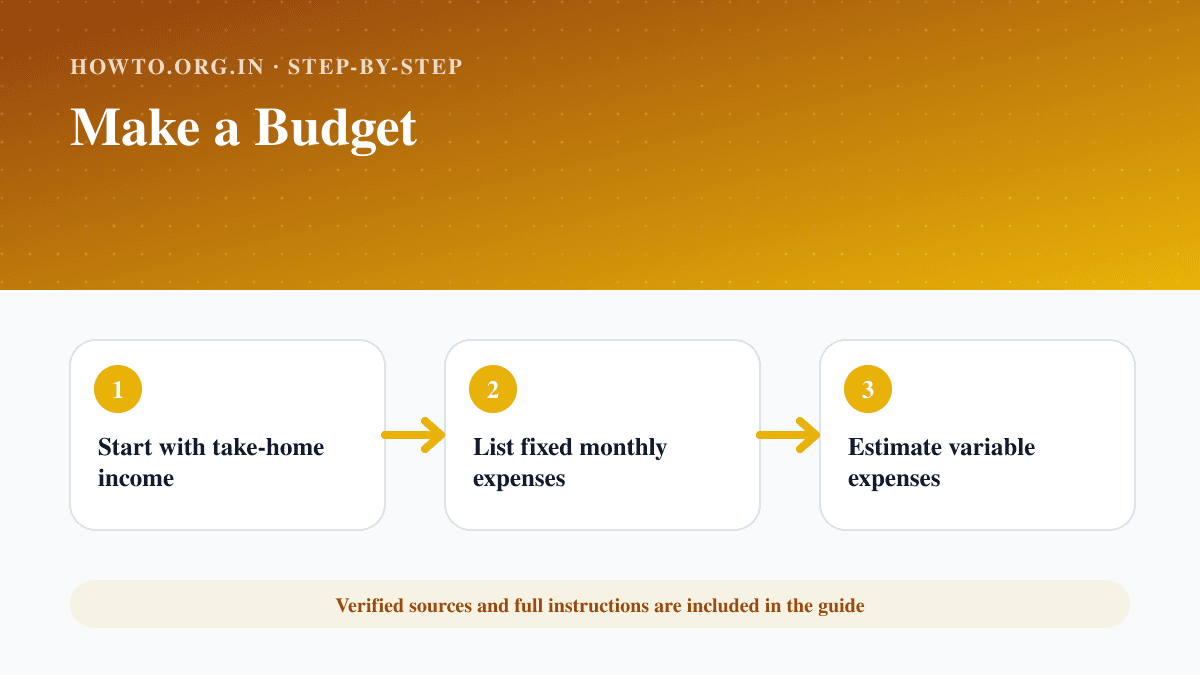
Start with take-home income
Use the amount you actually receive after taxes, payroll deductions, and regular withholdings. If your income changes each month, start with a conservative average or your lowest recent month.
- Step 2
List fixed monthly expenses
Write down predictable costs such as rent or mortgage, utilities, insurance, minimum debt payments, phone, internet, school fees, and subscriptions.
- Step 3
Estimate variable expenses
Review recent spending for groceries, fuel, transport, medical costs, dining out, shopping, entertainment, gifts, and small cash purchases. Use real spending history, not guesses, when possible.
- Step 4
Separate needs, wants, savings, and debt
Needs are essential costs. Wants are flexible lifestyle costs. Savings and extra debt payments are future-focused categories. This split makes it easier to see where changes are possible.
- Step 5
Try the 50/30/20 rule as a simple starting point
With this method, 50% of take-home income goes to needs, 30% to wants, and 20% to savings or extra debt payments. Treat it as a guide, not a strict rule, because housing, income, family size, and debt vary.
- Step 6
Use zero-based budgeting if you want more control
With zero-based budgeting, every rupee or dollar gets assigned to a category until income minus planned spending, saving, and debt payment equals zero. This does not mean spending everything; savings is a category.
- Step 7
Choose realistic category limits
Set limits that reflect your actual life. A budget that removes every enjoyable purchase is often hard to follow. Start with small changes that you can repeat for several months.
- Step 8
Add irregular expenses
Include yearly, quarterly, or occasional costs such as car maintenance, school supplies, insurance renewals, gifts, festivals, travel, medical expenses, and repairs by saving a monthly amount for them.
- Step 9
Track actual spending during the month
Update your notebook, spreadsheet, or app at least weekly. Tracking shows whether your plan matches reality and helps you adjust before the month ends.
- Step 10
Review and adjust next month
At month-end, compare planned spending with actual spending. Keep what worked, change what did not, and update income, bills, and goals before the next month begins.
Practical Example
Example: A household has $4,000 monthly take-home income. Using 50/30/20 as a starting point, needs target $2,000, wants target $1,200, and savings/debt target $800. Their draft budget is rent $1,250, utilities $220, groceries $500, transport $250, insurance $180, phone/internet $120, minimum debt $200, savings $500, extra debt $300, dining out $250, entertainment $150, shopping $150, and miscellaneous $130. Total planned spending, savings, and debt payments equals $4,000, so it also works as a zero-based budget.
Common Mistakes
- Budgeting from gross income instead of take-home income
- Forgetting annual or irregular expenses
- Making spending limits too strict to follow
- Not tracking small purchases
- Leaving out minimum debt payments or emergency savings
- Treating the 50/30/20 rule as mandatory even when it does not fit your situation
- Quitting after one imperfect month instead of adjusting the plan
Troubleshooting
My expenses are higher than my income
First separate essentials from flexible spending. Look for subscription cuts, bill negotiations, lower-cost alternatives, or temporary reductions. If debt or essentials are unmanageable, consider speaking with a qualified nonprofit credit counselor or financial professional.
My income changes every month
Use a conservative income estimate, build a buffer category, and update the budget when income arrives. Prioritize essentials before wants.
The 50/30/20 rule does not fit my life
Adjust the percentages. High housing costs, debt, family responsibilities, or low income may require a different split. The goal is a workable plan, not perfect percentages.
I keep overspending in one category
Check whether the limit is unrealistic or whether another category can be reduced. If groceries, fuel, or medical costs changed, update the budget rather than pretending the old number still works.
I forget to update the budget
Set a weekly reminder, use bank alerts, or choose one simple tool. A basic spreadsheet you update regularly is better than a complicated app you ignore.
Sources and Review
Reviewed by Pramod Tiwari, Editor; official-source verification on 2026-08-08.
- Financial Awareness (FAME) Booklet — Reserve Bank of India
- Creating a Cash Flow Budget — Consumer Financial Protection Bureau
Helpful Internal Links
FAQs
What is the easiest budget method for beginners?
The 50/30/20 rule is often the easiest starting point because it uses only three broad categories: needs, wants, and savings or debt payments.
What is zero-based budgeting?
Zero-based budgeting means assigning every unit of income to spending, saving, debt payment, or another category until nothing is left unplanned.
Should I use a spreadsheet, app, or notebook?
Use the tool you will actually update. A spreadsheet is flexible, an app can automate tracking, and a notebook can work well if you prefer simple manual records.
How often should I review my budget?
Review spending at least weekly and rebuild the budget monthly. Also update it after income, rent, debt, family, or job changes.
How much should I save every month?
There is no single right amount for everyone. Start with what is realistic for your income, essential expenses, debt, and goals, then increase it when possible.
Is this financial advice?
No. This is educational content. Make decisions based on your own financial situation and consider qualified professional help for debt, tax, investment, or emergency financial issues.
Related Guides
How to Build an Emergency Fund
Set an emergency-fund target, open a safe accessible account, automate contributions and define when the money can be used.
How to Save Money
Learn how to save money with expense tracking, savings goals, automatic transfers, bill review, spending limits, mistakes to avoid, troubleshooting, and FAQs.
How to Make Budget Friendly Meals
Learn how to make budget friendly meals with pantry staples, meal planning, batch cooking, leftovers, shopping tips, mistakes, and FAQs.
Help us improve this guide
Tell us about an outdated instruction, unclear step, broken link or safety concern. Do not include passwords, account numbers, medical records or other sensitive information.