
How to Save Money
Learn how to save money with expense tracking, savings goals, automatic transfers, bill review, spending limits, mistakes to avoid, troubleshooting, and FAQs.
Quick Answer
To save money, track your spending, choose one clear savings goal, separate needs from wants, set a realistic monthly savings amount, automate the transfer after payday, reduce one or two recurring costs, plan flexible spending, and review your progress every week.
What You Need Before Saving
- Monthly income estimate
- List of bills and debt payments
- Recent bank or card transactions
- A savings goal
- Separate savings account or tracking method
- Budget notebook, spreadsheet, or app
Safety Precautions
- This is educational information, not personalized financial advice.
- Keep enough cash for essential bills before moving money to savings.
- Avoid risky products or investments just because they promise fast results.
- Base decisions on your own income, debts, household needs, and emergency situation.
Step-by-Step Instructions
- Step 1
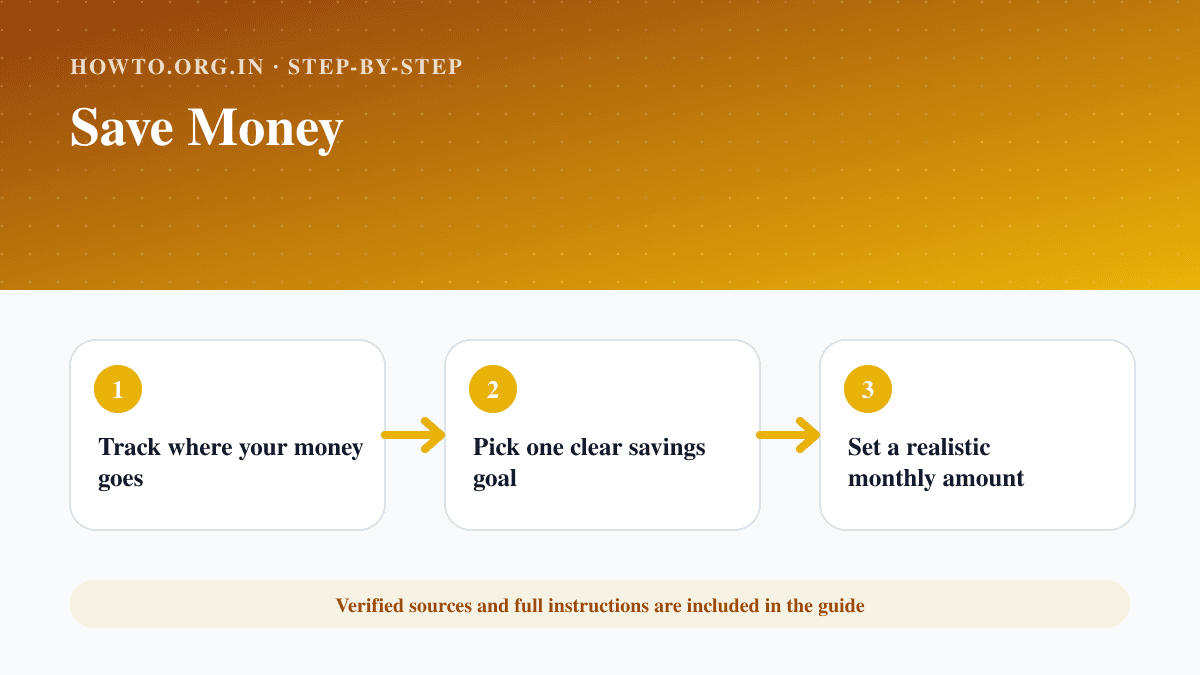
Track where your money goes
Review one month of transactions and group spending into housing, food, transport, bills, debt, subscriptions, savings, and flexible spending.
- Step 2
Pick one clear savings goal
Choose a specific goal such as emergency fund, rent deposit, travel, repair fund, or debt buffer. A clear goal makes saving easier.
- Step 3
Set a realistic monthly amount
Start with an amount you can repeat. Even a small automatic transfer builds the habit.
- Step 4
Pay yourself first
Move savings shortly after income arrives, before optional spending absorbs it.
- Step 5
Cut one recurring cost
Cancel unused subscriptions, renegotiate a bill, switch plans, or pause one low-value habit.
- Step 6
Plan flexible spending
Give yourself a limit for eating out, shopping, entertainment, and impulse buys instead of relying on willpower.
- Step 7
Use a waiting rule
For non-urgent purchases, wait 24 to 72 hours. Many impulse purchases lose urgency.
- Step 8
Review weekly
Check your account and spending once a week. Adjust the next week before the month goes off track.
Practical Example
Example: You earn $3,000 monthly and want a $1,000 emergency fund. You find $80 in unused subscriptions and dining-out cuts, automate $150 after payday, and review spending every Sunday. In about seven months, the emergency fund is complete if no emergencies interrupt it.
Common Mistakes
- Trying to save an unrealistic amount immediately
- Saving without tracking spending
- Forgetting irregular expenses
- Keeping savings in the same spending account
- Using credit cards to maintain old habits
- Treating every sale as a saving opportunity
Troubleshooting
I cannot save anything
Start by tracking and protecting essentials. Then look for one small recurring cut or income timing fix. If bills exceed income, focus on assistance, debt help, or income changes first.
I keep dipping into savings
Separate savings from checking, name the account after the goal, and keep a small planned fun budget so the plan is livable.
Unexpected expenses ruin the plan
Create sinking funds for irregular costs such as car repairs, annual fees, school costs, or gifts.
My income changes every month
Budget from a conservative income estimate and save more in higher-income months.
Sources and Review
Reviewed by Pramod Tiwari, Editor; official-source verification on 2026-08-08.
- Financial Awareness (FAME) Booklet — Reserve Bank of India
- An Essential Guide to Building an Emergency Fund — Consumer Financial Protection Bureau
Helpful Internal Links
FAQs
How much money should I save each month?
There is no universal percentage. Start with an amount that does not put essential bills at risk, repeat it consistently, and adjust it when your income or costs change.
Should I save or pay off debt first?
Many people keep a small emergency buffer while paying high-interest debt. The best choice depends on your rates, risk, obligations, and access to emergency cash.
Where should I keep emergency savings?
Use a safe, accessible account separate from daily spending. Avoid putting emergency money somewhere volatile or hard to access.
Is saving money worth it if I can save only a little?
Yes. Small repeated savings build the habit and create a cushion for minor emergencies.
Related Guides
How to Make a Budget
Learn how to make a personal or household budget with income, expenses, the 50/30/20 rule, zero-based budgeting, a monthly example, mistakes, troubleshooting, and FAQs.
How to Build an Emergency Fund
Set an emergency-fund target, open a safe accessible account, automate contributions and define when the money can be used.
How to Fill Out a Money Order
Learn how to fill out a money order with payee name, purchaser details, memo line, signature, receipt tracking, common mistakes, troubleshooting, and FAQs.
Help us improve this guide
Tell us about an outdated instruction, unclear step, broken link or safety concern. Do not include passwords, account numbers, medical records or other sensitive information.