
How to Check Tire Pressure
Learn how to check tire pressure safely with a gauge, find the correct PSI, add or release air, avoid common mistakes, and troubleshoot low-pressure warnings.
Quick Answer
To check tire pressure, park on level ground, let the tires cool, find the recommended PSI on the driver-side door sticker or owner manual, remove the valve cap, press a tire gauge firmly onto the valve stem, read the PSI, then add or release air until each tire matches the recommended cold pressure.
Tools Required
- Tire pressure gauge
- Air compressor or gas-station air pump
- Owner manual or driver-side door PSI sticker
- Valve caps
- Pen or phone note if front and rear PSI are different
Safety Precautions
- Check tires when they are cold, ideally before driving or after the car has been parked for several hours.
- Use the vehicle maker recommended PSI, not the maximum PSI printed on the tire sidewall.
- Do not drive on a visibly flat, damaged, bulging, or severely underinflated tire.
- Keep hands and clothing clear of moving traffic if checking pressure at a roadside pump.
Step-by-Step Instructions
- Step 1
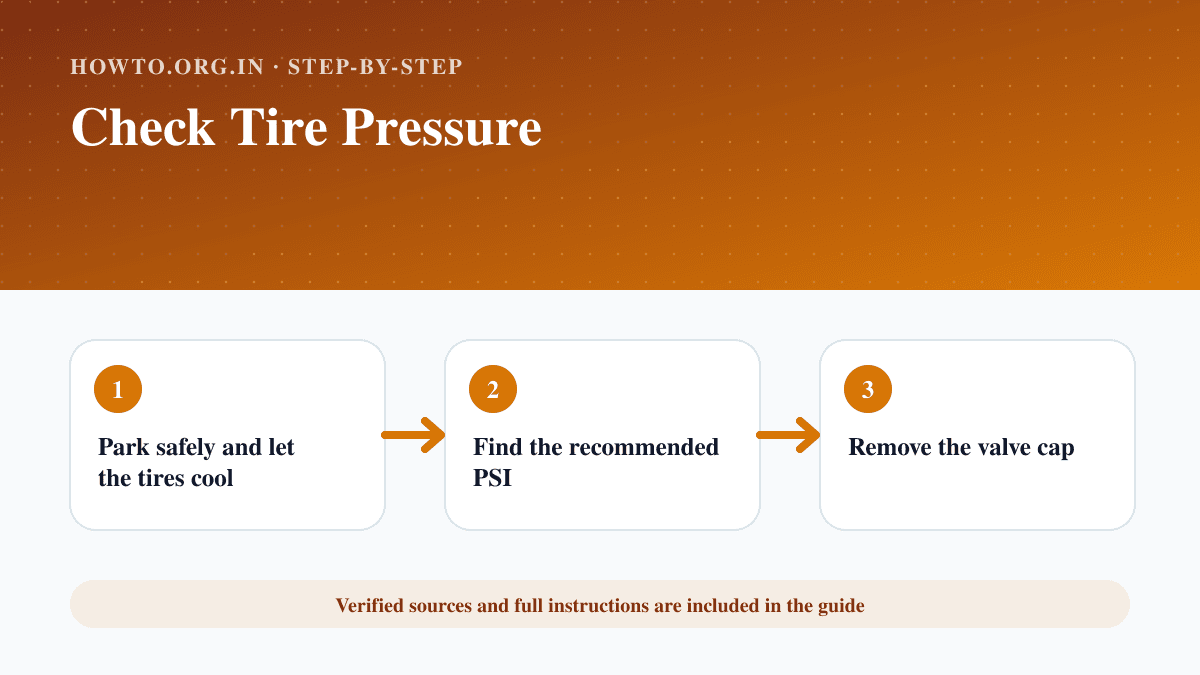
Park safely and let the tires cool
Choose level ground away from moving traffic. Cold-tire pressure gives the most useful reading because driving heats tires and raises pressure.
- Step 2
Find the recommended PSI
Look at the driver-side door jamb sticker or your owner manual. Front and rear tires may use different pressure numbers.
- Step 3
Remove the valve cap
Unscrew the cap from one tire valve and place it somewhere safe so it does not roll away.
- Step 4
Press the gauge straight onto the valve
Push the gauge firmly until the hissing stops and the gauge shows a reading. If air leaks around the gauge, reseat it and try again.
- Step 5
Compare the reading with the recommended PSI
Write down the result if needed, especially when checking all four tires plus the spare.
- Step 6
Add air if pressure is low
Connect the pump to the valve stem and add air in short bursts. Recheck with the gauge after each burst.
- Step 7
Release air if pressure is too high
Press the small valve pin briefly with the gauge tip or a valve tool, then recheck. Work slowly so you do not remove too much air.
- Step 8
Replace the valve cap and repeat
Tighten the cap by hand and repeat the process for every tire. Check the spare tire periodically too.
Practical Example
Example: Your door sticker says 35 PSI front and rear. Your left-front tire reads 30 PSI, so you add air in two short bursts, recheck, and stop at 35 PSI. You repeat the same process on the other tires.
Common Mistakes
- Using the tire sidewall maximum pressure as the target
- Checking immediately after a long drive and treating the warm reading as cold pressure
- Forgetting the spare tire
- Ignoring repeated pressure loss
- Leaving valve caps off
- Relying only on the dashboard warning light
Troubleshooting
The gauge keeps hissing
The gauge is not seated squarely. Remove it, align it straight with the valve stem, and press firmly again.
The tire loses pressure again after filling
Check for a nail, damaged valve stem, cracked sidewall, or rim leak. Have a tire shop inspect it.
The TPMS light stays on
Recheck all tires, including the spare if your vehicle monitors it. Some vehicles need a short drive or manual reset after correction.
The air pump reading differs from your gauge
Use one reliable gauge consistently. Gas-station pump gauges can be worn or inaccurate.
Sources and Review
Reviewed by Pramod Tiwari, Editor; official-source verification on 2026-08-08.
- Tire Safety Ratings and Awareness (TireWise) — National Highway Traffic Safety Administration
Helpful Internal Links
FAQs
How often should I check tire pressure?
Check at least monthly and before long trips. Also check when the weather changes sharply or the car feels unusual.
Where do I find the correct tire pressure?
Use the driver-side door sticker or owner manual. Do not use the maximum pressure printed on the tire sidewall as your normal target.
Should all four tires have the same PSI?
Many cars use the same PSI front and rear, but some do not. Follow your vehicle sticker or manual.
Can I drive with low tire pressure?
Avoid driving on a visibly low or flat tire. Low pressure can damage the tire and affect handling.
Related Guides
How to Change a Tire
Learn how to change a flat tire safely with a tool checklist, safety warnings, step-by-step instructions, troubleshooting, common mistakes, and FAQs.
How to Change Oil
Learn how to change engine oil safely at home, choose the right oil, replace the filter, check for leaks, dispose of used oil, and avoid common mistakes.
How to Check Oil
Learn how to check engine oil with a dipstick, read the level correctly, add oil safely, spot warning signs, and know when to visit a mechanic.
Help us improve this guide
Tell us about an outdated instruction, unclear step, broken link or safety concern. Do not include passwords, account numbers, medical records or other sensitive information.