
How to Change a Tire
Learn how to change a flat tire safely with a tool checklist, safety warnings, step-by-step instructions, troubleshooting, common mistakes, and FAQs.
Quick Answer
To change a tire, pull over on flat ground away from traffic, turn on hazard lights, set the parking brake, place wheel chocks, loosen the lug nuts before lifting, jack the vehicle at the correct jack point, remove the flat tire, mount the spare, hand-tighten the lug nuts, lower the car, tighten the nuts in a star pattern, and drive slowly to a tire shop.
Tools Required
- Properly inflated spare tire or temporary spare
- Vehicle jack rated for your car
- Lug wrench or tire iron
- Owner’s manual for jack points and spare-tire limits
- Wheel chocks or sturdy blocks
- Flashlight or headlamp if visibility is poor
- Gloves and reflective vest if available
- Tire pressure gauge and portable inflator if available
Safety Precautions
- Do not change a tire in an active lane, on a narrow shoulder, on a curve, or anywhere you feel unsafe.
- Use hazard lights before you stop and keep passengers away from traffic.
- Set the parking brake and chock the wheels opposite the flat tire before lifting the vehicle.
- Loosen lug nuts only while the tire is on the ground; never put force on the wrench while the vehicle is unstable on the jack.
- Use only the vehicle’s approved jack point and never place hands, feet, or any part of your body under a raised car.
- Treat temporary spares as short-distance emergency equipment and check the owner’s manual for speed and distance limits.
Step-by-Step Instructions
- Step 1
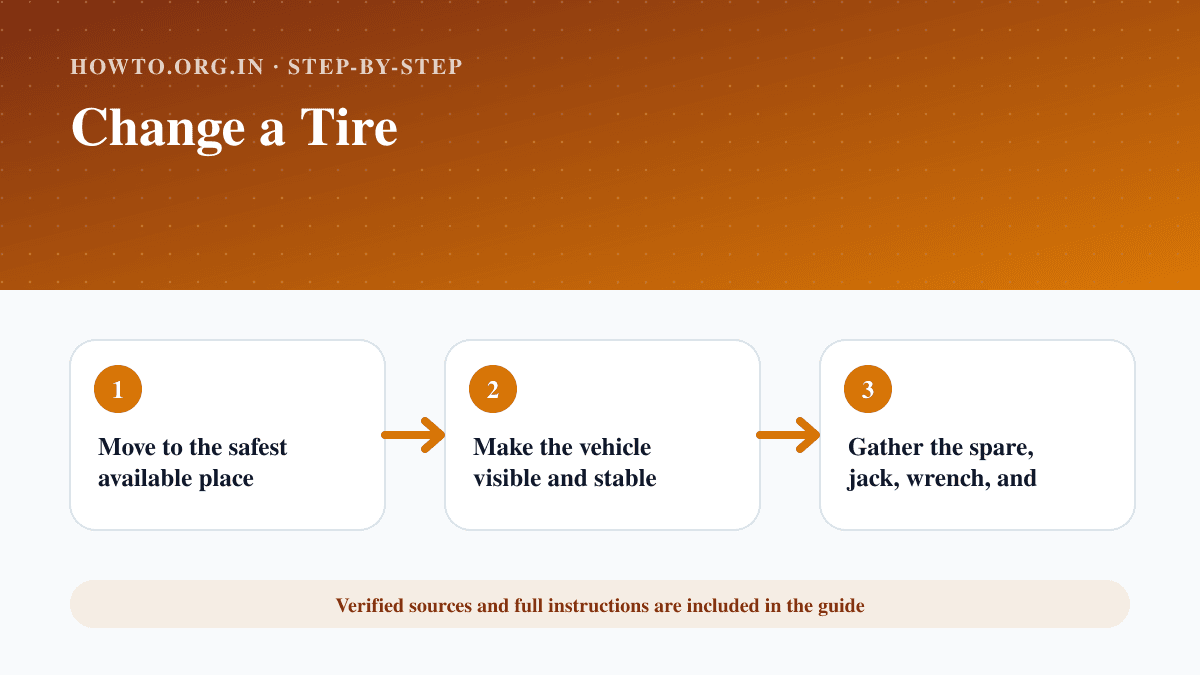
Move to the safest available place
Slow down gradually, avoid sudden steering, and pull into a parking lot, side street, wide shoulder, or another flat area away from traffic. If the location feels unsafe, call roadside assistance instead.
- Step 2
Make the vehicle visible and stable
Turn on hazard lights, place the transmission in park or in gear for a manual car, set the parking brake, and ask passengers to stand away from the road. Place chocks in front of or behind the wheels opposite the flat tire.
- Step 3
Gather the spare, jack, wrench, and manual
Take out the spare tire, jack, lug wrench, and owner’s manual before lifting the vehicle. Confirm where the jack should contact the frame and check whether your spare has a speed or distance limit.
- Step 4
Remove the hubcap if needed
If a hubcap or wheel cover blocks the lug nuts, remove it using the flat end of the lug wrench or the method listed in your owner’s manual. Skip this step if the lug nuts are already exposed.
- Step 5
Loosen the lug nuts before lifting
Turn each lug nut counterclockwise about a quarter to half turn while the tire is still touching the ground. Use a star or crisscross pattern so the wheel stays evenly seated.
- Step 6
Place the jack at the approved jack point
Position the jack under the reinforced metal jack point near the flat tire. Keep it vertical and stable. If the ground is soft, use a solid board under the jack only if it sits flat and cannot slip.
- Step 7
Raise the vehicle just enough
Lift the car until the flat tire clears the ground by several inches. Do not lift higher than needed, and do not reach under the vehicle while it is supported only by the emergency jack.
- Step 8
Remove the lug nuts and flat tire
Finish removing the lug nuts and keep them together in a safe spot. Grip the tire with both hands and pull it straight toward you. Lay the flat tire on its side so it cannot roll.
- Step 9
Mount the spare tire
Line up the spare with the wheel studs, push it fully onto the hub, and make sure it sits flat against the mounting surface.
- Step 10
Hand-tighten the lug nuts
Thread each lug nut by hand first to avoid cross-threading. Tighten them snugly in a star pattern, but do not fully torque them while the wheel is still off the ground.
- Step 11
Lower the car and fully tighten the nuts
Lower the vehicle until the spare touches the ground and cannot spin, then tighten the lug nuts firmly in a star pattern. Lower the car completely, remove the jack, and check the nuts again.
- Step 12
Stow tools and drive carefully
Put the flat tire, jack, wrench, and chocks back in the vehicle. Check the spare tire pressure if you can, then drive slowly to a tire shop to repair or replace the damaged tire.
Practical Example
Example: You notice a flat rear tire in a grocery store parking lot. You park on a flat section away from moving cars, turn on hazards, set the parking brake, chock the front wheels, loosen the rear lug nuts, jack the car at the rear jack point, install the spare, tighten the nuts in a star pattern, and drive directly to a nearby tire shop.
Common Mistakes
- Trying to change the tire too close to traffic
- Forgetting to set the parking brake
- Jacking the car from plastic trim, suspension parts, or an unapproved point
- Removing lug nuts before the vehicle is lifted
- Fully tightening lug nuts while the car is still high on the jack
- Driving normally on a temporary spare
- Not checking the spare tire pressure before continuing
Troubleshooting
The lug nuts will not loosen
Confirm you are turning counterclockwise. Use steady downward pressure on the wrench while the tire is still on the ground. If the nuts still do not move, call roadside assistance rather than shaking the car on the jack.
The car feels unstable on the jack
Stop immediately, lower the vehicle, reposition on flatter ground if safe, and confirm the jack is on the correct reinforced jack point. Do not continue if the jack leans or sinks.
The spare will not slide onto the studs
Check alignment, lift the car slightly higher if the spare is taller than the flat, and make sure the wheel is facing the correct direction.
The spare tire looks low
Use a tire gauge or portable inflator if available. If the spare is visibly flat or damaged, do not drive on it; call for roadside help or towing.
The hubcap does not fit after installing the spare
Store the hubcap in the vehicle. Many temporary spare tires do not accept the original wheel cover.
When Not to Change the Tire Yourself
- You are on a freeway shoulder, blind curve, bridge, tunnel, hill, or any place where traffic is close.
- The ground is sloped, soft, icy, muddy, or uneven.
- You do not have a spare, jack, lug wrench, wheel lock key, or safe jack point information.
- The tire damage follows a crash or the wheel, suspension, or brake area looks damaged.
- You feel physically unable to loosen the nuts, lift the tire, or work safely.
- Weather, darkness, or visibility makes the roadside unsafe.
Emergency Roadside Safety Tips
- Stay calm, slow down gradually, and avoid hard braking after a blowout.
- Turn on hazard lights as soon as you realize there is a tire problem.
- If a safer parking lot or exit is close, it may be safer to drive slowly on the flat for a short distance than stop in traffic.
- Keep passengers away from the traffic side of the vehicle.
- Use reflective triangles or a vest if you have them, but only place them when it is safe to exit.
- After installing the spare, avoid high speeds and go to a tire shop as soon as possible.
Sources and Review
Reviewed by Pramod Tiwari, Editor; official-source verification on 2026-08-08.
- How to Change a Tire in 11 Easy Steps — AAA
- Tire Safety Ratings and Awareness (TireWise) — National Highway Traffic Safety Administration
Helpful Internal Links
FAQs
How long does it take to change a tire?
Most beginners need about 20 to 40 minutes if the vehicle is in a safe, flat location and all tools are available. Safety matters more than speed.
Should I loosen lug nuts before jacking up the car?
Yes. Loosen the lug nuts while the tire is still on the ground because the wheel is more stable and less likely to spin.
Can I change a tire on a slope?
No. A slope increases the chance of the vehicle rolling or slipping off the jack. Move to flat ground or call roadside assistance.
How tight should lug nuts be?
Tighten them firmly in a star pattern, then have the torque checked at a tire shop or service station. Your owner’s manual lists the correct torque specification.
How far can I drive on a temporary spare tire?
Follow the limit printed on the spare tire or in your owner’s manual. Many temporary spares are intended only for short, low-speed trips to a repair shop.
What if my car does not have a spare tire?
Some cars include an inflator kit instead of a spare. If the tire has sidewall damage, a blowout, or a large puncture, an inflator may not help and you may need towing.
Related Guides
How to Change Oil
Learn how to change engine oil safely at home, choose the right oil, replace the filter, check for leaks, dispose of used oil, and avoid common mistakes.
How to Check Tire Pressure
Learn how to check tire pressure safely with a gauge, find the correct PSI, add or release air, avoid common mistakes, and troubleshoot low-pressure warnings.
How to Check Oil
Learn how to check engine oil with a dipstick, read the level correctly, add oil safely, spot warning signs, and know when to visit a mechanic.
Help us improve this guide
Tell us about an outdated instruction, unclear step, broken link or safety concern. Do not include passwords, account numbers, medical records or other sensitive information.