
How to Jumpstart a Car
Learn how to jumpstart a car safely with jumper cables or a jump starter, connect clamps in the right order, avoid mistakes, and know when to call help.
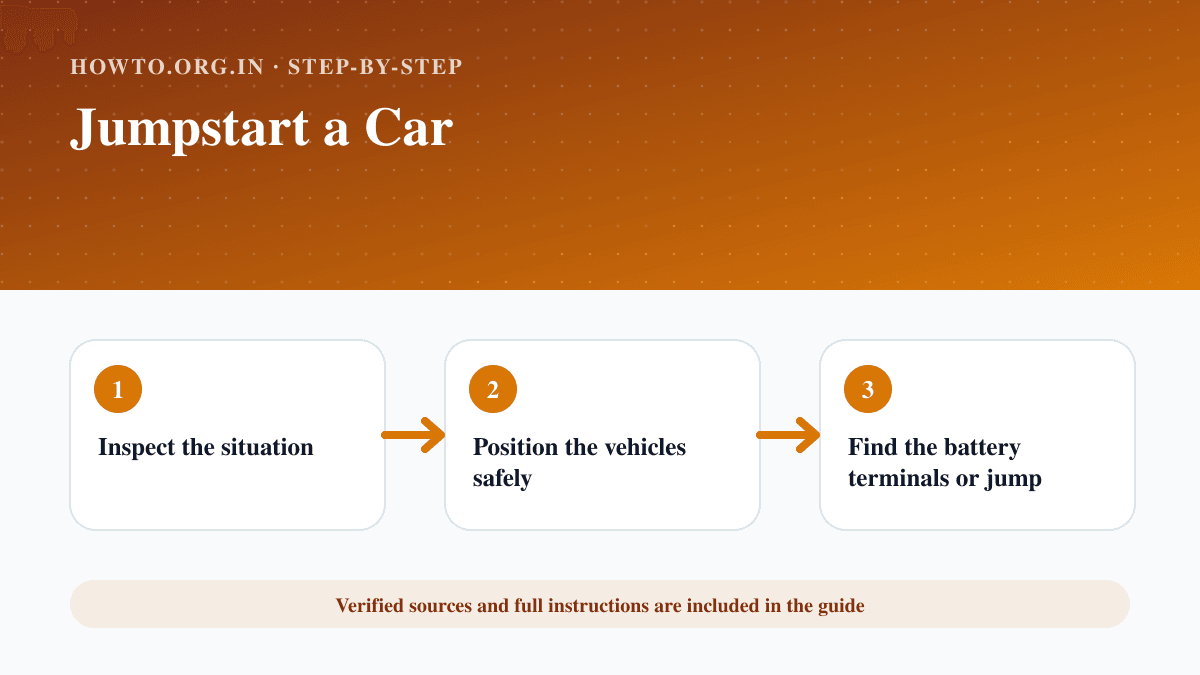
Quick Answer
To jumpstart a car, park a working vehicle close without touching, turn both cars off, connect red to the dead battery positive terminal, red to the good battery positive terminal, black to the good battery negative terminal, and the final black clamp to an unpainted metal ground on the dead car. Start the working car, wait a few minutes, start the dead car, then remove cables in reverse order.
Tools Required
- Jumper cables or a charged portable jump starter
- Working donor vehicle if using cables
- Owner manuals for both vehicles
- Safety glasses and gloves if available
- Flashlight if visibility is poor
Safety Precautions
- Do not jumpstart a frozen, cracked, leaking, swollen, or visibly damaged battery.
- Keep cable clamps from touching each other once connected.
- Confirm battery terminals and jump points in the owner manual, especially on hybrids, EVs, and vehicles with remote battery posts.
- Do not smoke or create sparks near a battery.
- If you are unsure, call roadside assistance.
Step-by-Step Instructions
- Step 1
Inspect the situation
Make sure the battery is not cracked, leaking, swollen, frozen, or giving off a strong rotten-egg smell. If it is, stop and call help.
- Step 2
Position the vehicles safely
Park the working car close enough for the cables to reach, but do not let the vehicles touch. Set both parking brakes and turn off lights, radios, and accessories.
- Step 3
Find the battery terminals or jump points
Identify positive and negative terminals. Some vehicles have dedicated jump posts away from the battery.
- Step 4
Connect the first red clamp
Attach one red clamp to the positive terminal or jump post on the dead battery.
- Step 5
Connect the second red clamp
Attach the other red clamp to the positive terminal on the good battery.
- Step 6
Connect the black clamp to the good battery
Attach one black clamp to the negative terminal on the good battery.
- Step 7
Connect the final black clamp to ground
Attach the final black clamp to clean, unpainted metal on the engine block or chassis of the dead vehicle, away from the battery when possible.
- Step 8
Start the working vehicle
Let it idle for a few minutes so the dead battery receives some charge.
- Step 9
Start the dead vehicle
Try starting the dead car. If it does not start after a few tries, stop and call help rather than overheating the starter.
- Step 10
Remove the cables in reverse order
Remove black ground, black good battery, red good battery, then red dead battery. Keep clamps separated.
- Step 11
Let the revived car run
Drive or idle long enough to recharge, then have the battery and charging system checked if the problem returns.
Practical Example
Example: Your car clicks in a parking lot. A friend parks nearby, both cars are off, and you connect red-positive to dead, red-positive to good, black-negative to good, black to a metal ground on your car. After a few minutes, your car starts and you drive to a battery shop for testing.
Common Mistakes
- Connecting clamps in the wrong order
- Letting clamps touch each other
- Trying to jump a damaged battery
- Ignoring owner-manual jump points
- Cranking the dead car repeatedly for too long
- Assuming a jump fixes a failing battery permanently
Troubleshooting
The car still will not start
Check clamp contact, wait a few more minutes, and try again briefly. If it still fails, the battery, starter, alternator, or cable connection may need service.
You see sparks or smell sulfur
Stop immediately, step away, and call roadside assistance.
The revived car dies again
The alternator or battery may be failing. Have the charging system tested.
The battery is hidden
Look for remote jump posts in the engine bay or check the owner manual.
When to Visit a Mechanic
- The car needs repeated jumpstarts.
- The battery is more than a few years old and tests weak.
- The battery warning light appears while driving.
- Cables are corroded, loose, or damaged.
- You suspect alternator or starter failure.
Sources and Review
Reviewed by Pramod Tiwari, Editor; official-source verification on 2026-08-08.
Helpful Internal Links
FAQs
Do I connect red or black first?
Connect the red positive clamps first, then black to the good battery negative and final black to a metal ground on the dead vehicle.
Can I use a portable jump starter?
Yes, if it is charged and rated for your vehicle. Follow the jump starter manual exactly.
How long should I drive after a jumpstart?
A short drive may not fully recharge a weak battery. Drive to a safe place and consider battery testing.
Can jumpstarting damage electronics?
Incorrect connections can damage electronics. Use the correct order and owner-manual jump points.
Related Guides
How to Change a Tire
Learn how to change a flat tire safely with a tool checklist, safety warnings, step-by-step instructions, troubleshooting, common mistakes, and FAQs.
How to Check Tire Pressure
Learn how to check tire pressure safely with a gauge, find the correct PSI, add or release air, avoid common mistakes, and troubleshoot low-pressure warnings.
How to Check Oil
Learn how to check engine oil with a dipstick, read the level correctly, add oil safely, spot warning signs, and know when to visit a mechanic.
Help us improve this guide
Tell us about an outdated instruction, unclear step, broken link or safety concern. Do not include passwords, account numbers, medical records or other sensitive information.